


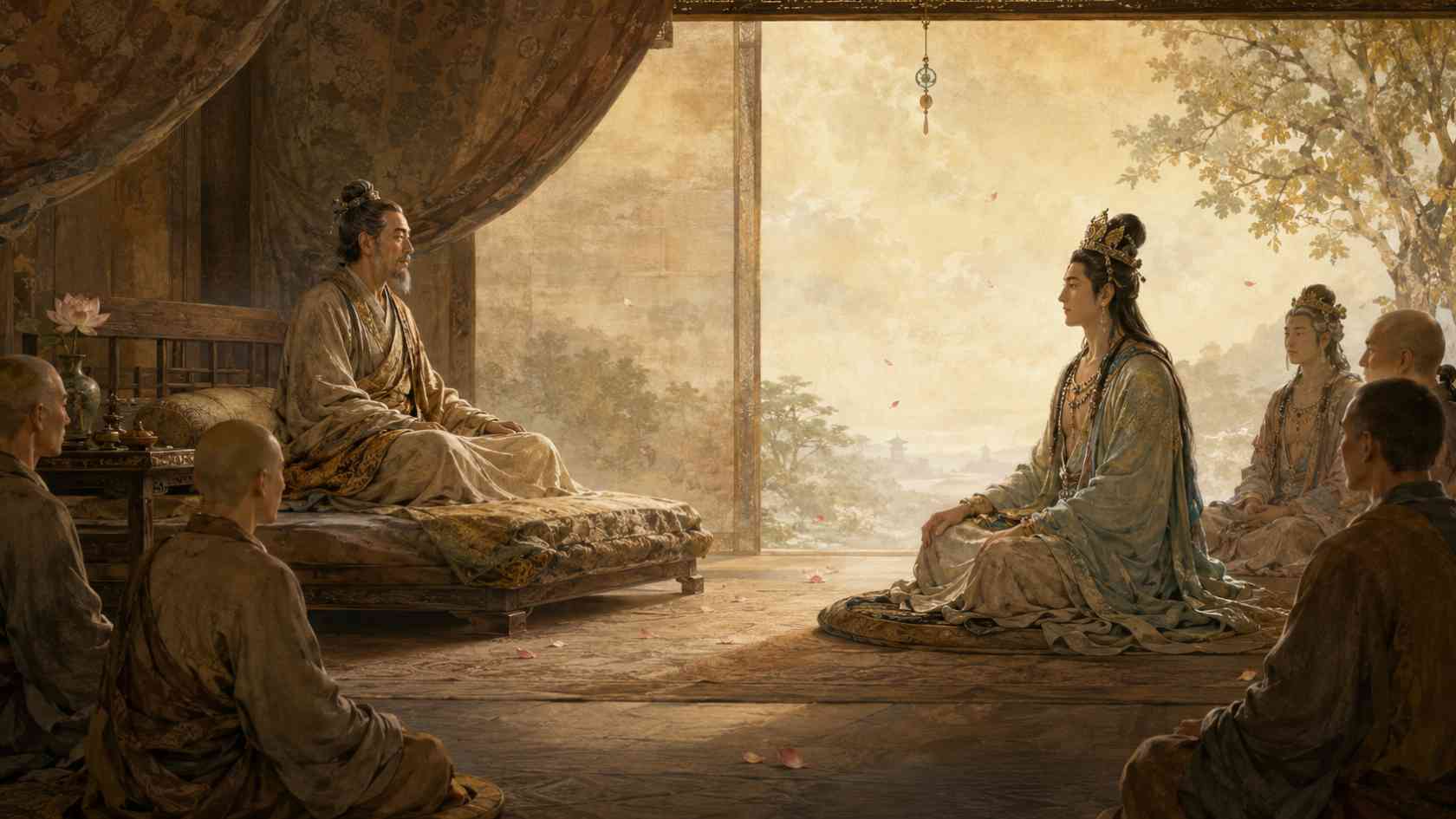
In this Dharma workshop, we will study the Vimalakirti Sutra and its message that practice leads us to an inconceivable freedom.
Is it possible to realize awakening without withdrawing from family, work, and everyday responsibilities? Does practicing the Dharma require us to retreat from the world, or can it fully manifest in the midst of society?
The Vimalakirti Sutra answers these questions through an exceptional figure: a lay practitioner living in the city of Vaishali who embodies the wisdom and compassion of the bodhisattva. Through vivid language, dialogues, paradoxes, and surprising scenes, the sutra shows us that the Way is not separate from everyday life.
This workshop is part of the Zen Dharma Course at Zen Kannon Barcelona and can be attended independently.
What Is the Vimalakirti Sutra?
The Vimalakirti Sutra is one of the best-known texts of Mahayana Buddhism. Its events are set during the time of Shakyamuni Buddha, but the text was composed in India during the first centuries of the Common Era and had a major influence on Chinese Buddhism and the subsequent Chan tradition, from which Zen emerged.
The sutra explores several major teachings of Mahayana Buddhism: emptiness, nonduality, the compassion of the bodhisattva, skillful means, and the possibility of practicing the Dharma in the midst of the world.
Its form is particularly original. Instead of presenting an abstract exposition, it depicts situations filled with humor and irony in which the Buddha’s most respected disciples find their ideas about meditation, purity, and awakening challenged.
Who Was Vimalakirti?
Vimalakirti is presented as a wealthy merchant who lives with his family in the city of Vaishali. Although he is a lay practitioner, his understanding of the Dharma is so profound that the Buddha’s disciples do not dare visit him or debate with him.
Vimalakirti participates fully in society. He interacts with merchants, rulers, ascetics, and people from every walk of life. He does not reject the world; instead, he enters every situation to help beings according to their needs.
His example shows that awakening does not depend on social position, monastic status, or outward appearances. What defines a bodhisattva is the ability to act with wisdom and compassion in any circumstance.
Vimalakirti’s Illness
At the beginning of the sutra, Vimalakirti falls ill. The Buddha asks his disciples to visit him, but each remembers an occasion when Vimalakirti exposed the limitations of their understanding. Finally, Manjushri, the bodhisattva of wisdom, agrees to go.
When Manjushri asks about the cause of his illness, Vimalakirti explains that he is ill because all beings are ill. As long as beings remain dominated by ignorance, greed, and hatred, the bodhisattva shares their suffering.
His illness, therefore, is not an individual matter. It arises from great compassion and expresses the profound interdependence of all beings. As we explain in Vimalakirti’s Illness, the bodhisattva does not seek a separate salvation but the awakening of everyone.
The Gate of Nonduality in the Vimalakirti Sutra
One of the sutra’s most famous passages is the dialogue on nonduality. Several bodhisattvas try to explain what it means to transcend oppositions such as self and others, samsara and nirvana, purity and impurity, or awakening and delusion.
Finally, Manjushri declares that entering nonduality means letting go of all words and explanations. He then asks Vimalakirti to present his teaching.
Vimalakirti responds by remaining silent.
This silence does not mean he has nothing to say. It expresses an understanding that cannot be confined within concepts. Whenever we try to define reality, we inevitably divide it. Vimalakirti’s silence points to direct experience, prior to all separation.
This scene had a profound influence on Zen, which emphasizes direct realization beyond words without rejecting teachings or the study of the Dharma.
The Goddess and the Emptiness of Identities
In another scene, a goddess causes flowers to fall upon those present. The flowers slide spontaneously off the bodies of the bodhisattvas but cling to Shariputra’s robes, and he tries to remove them. The goddess explains that the flowers make no distinctions: it is his mind that still clings to ideas of purity and impurity.
When Shariputra asks why she does not abandon her female body, the goddess magically exchanges her body with his. In this way, she shows that the identities we consider fixed have no inherent nature. Awakening belongs neither to men nor to women, neither to monks nor to laypeople. Buddha-nature does not depend on any particular form.
Bringing Practice into the World
Vimalakirti shows us a bodhisattva Way fully engaged with reality. Family life, work, relationships, illness, and conflict are not obstacles that must be eliminated before we can practice. They are precisely where wisdom and compassion can be actualized.
The practice of zazen allows us to experience this nonduality with our whole body. When we stop clinging to thoughts and identities, the separation between ourselves and others becomes less rigid. We can then respond to every situation with greater freedom and awareness.
During the workshop, we will read and discuss some of the sutra’s most significant passages and explore how its teachings can be brought into everyday practice.
The session will begin with zazen meditation. Zen teacher Lluís Nansen Salas will then give a talk on the text, followed by an opportunity for questions and discussion.
No prior reading of the sutra or knowledge of Buddhism is required. The workshop is open both to people taking their first steps in Zen and to practitioners who wish to deepen their understanding of the Dharma.
Dharma Workshop on the Vimalakirti Sutra
The workshop lasts two hours and includes meditation, a talk given by Zen teacher Lluís Nansen Salas, and a final question-and-answer discussion.
Location: Gran Via de les Corts Catalanes, 665, Barcelona.
Single session: 30 euros. Active members: 10 euros.
See information about the complete course: Zen Dharma Course.
Register for the Dharma Workshop on the Vimalakirti Sutra
2026/11/15 The inconceivable freedom. Vimalakirti Sutra
In this Dharma workshop, we will study the Vimalakirti Sutra and its message that practice…
2027/01/17 Dharma Workshop: The Heart Sutra. Sunday, January 17
The Heart Sutra The Heart Sutra, Hannya Shingyo as we call it in the Zen…
2027/02/21 Dharma Workshop on the Lotus Sutra. Sunday, Februrary 21
Origin of the Lotus Sutra The Lotus Sutra is a fundamental text in Mahayana Buddhism…
2027/04/18 Bodhisattva Way. Sunday, April 18
The Way of the Bodhisattva The Way of the Bodhisattva is an important concept in…

2027/05/16 Dharma Workshop: The Diamond Sutra. Sunday, May 16
The Diamond Sutra is an ancient Mahayana Buddhist text that is considered one of the…
2027/06/13 17h The Ten Foundations of Dogen’s Zen.
The Gakudō Yōjinshū, or Ten Foundations of Zen, is a work written by Eihei Dōgen,…
2027/07/18 Dharma Workshop: The Bodhisattva Precepts.
The Bodhisattva Precepts There is a story that clearly illustrates the meaning of the bodhisattva…
2027/09/19 Dharma workshop: The platform sutra of Huineng
The Platform Sutra of the Sixth Ancestor is one of the most influential texts in…
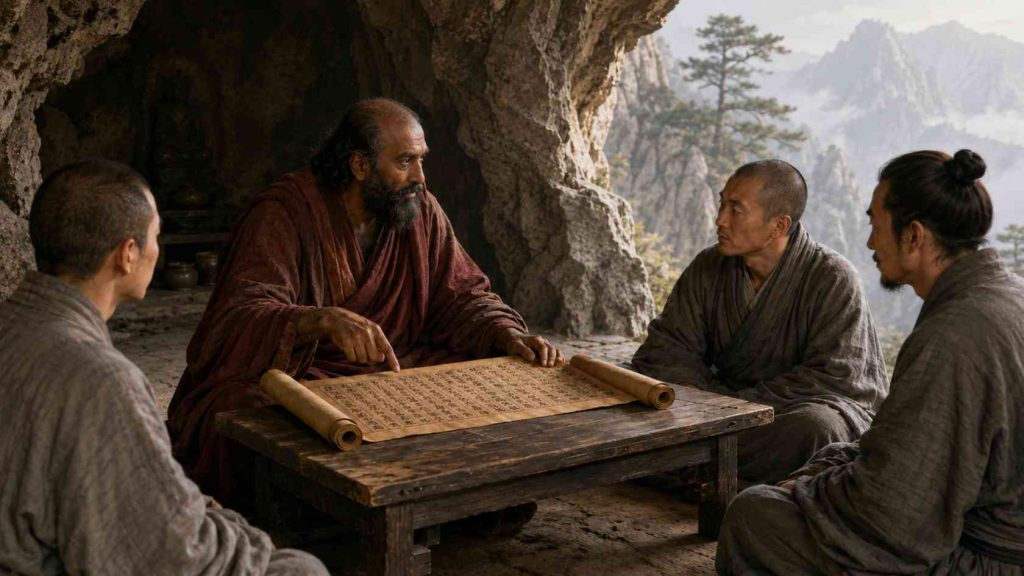
2027/10/10 Bodhidharma. Principle and practice
In this Dharma workshop, we will study Bodhidharma’s Principle and Practice and explore their relationship…