



In this Dharma workshop, we will study Bodhidharma’s Principle and Practice and explore their relationship with the Lankavatara Sutra.
What does it mean to practice Zen? Is understanding the Buddha’s teachings enough, or must we also transform the way we live? Bodhidharma, considered the first Zen ancestor in China, explained that there are two gateways to the Way: understanding the principle and engaging in concrete practice.
The first involves recognizing that all beings share buddha nature, even though this reality is often concealed by thoughts, prejudices, and the illusion of a separate self. The second involves expressing this understanding in everyday life: accepting difficulties, adapting to circumstances, ceasing to constantly pursue personal gain, and acting in accordance with the Dharma.
For Bodhidharma, understanding and practice are not separate. Genuine understanding is expressed through the way we live, and practice allows us to awaken to what we already are.
The Transmission of the Lankavatara Sutra
To explore this teaching more deeply, we will turn to the Lankavatara Sutra, one of the texts that most strongly influenced the origins of Zen. According to tradition, Bodhidharma transmitted it to his disciple Huike as a fundamental expression of the Dharma.
What is the relationship between this sutra, buddha nature, and the practice of zazen? And how can we understand a teaching that invites us to go beyond words?
In this Dharma Zen Course workshop, we will explore the Lankavatara Sutra, one of the fundamental texts of Mahayana Buddhism, and its influence on the teaching of Bodhidharma, considered the first Zen ancestor in China.
The relationship between this sutra and the birth of the Zen tradition will help us understand essential questions: What does it mean to know our own mind? What is the relationship between buddha nature and the practice of zazen? Why does awakening not depend solely on studying texts?
What Is the Lankavatara Sutra?
The Lankavatara Sutra presents a dialogue between the Buddha and the bodhisattva Mahamati about the nature of consciousness, reality, and awakening. The name Lankavatara refers to the island of Sri Lanka, where the Buddha is traditionally said to have delivered the teaching. The text was among the first to be translated into Chinese, with a particularly significant fifth-century translation associated with Gunabhadra. Bodhidharma, who is said to have arrived without any texts, reportedly used this Chinese translation of the Lankavatara as a reference when teaching local people.
One of the sutra’s central ideas is that the way we experience the world is profoundly conditioned by our own mind. Thoughts, habits, prejudices, and identifications create an interpretation of reality that we often mistake for reality itself. This does not mean that the external world does not exist. It means that we cannot separate what we perceive from how we perceive it. When we understand this process, we begin to see the extent to which suffering arises from identifying with our mental constructions.
Bodhidharma and the Transmission of the Sutra
According to tradition, Bodhidharma transmitted the Lankavatara Sutra to his disciple Huike, the second ancestor of Chinese Zen, as an expression of the essence of his teaching. The significance of this account is not merely historical. It also reveals an apparent contradiction: if Bodhidharma taught direct transmission beyond words, why did he give his disciple a text?
The answer is that words can guide practice, but they cannot replace direct experience. The sutra is not presented as a doctrine to be memorized, but as an invitation to recognize what can only be verified in one’s own life. This relationship between the text and wordless teaching has been examined in this study of the Lankavatara Sutra and Bodhidharma.
The Finger Pointing at the Moon
An image found in the sutra helps us understand this question: we must not confuse the finger pointing at the moon with the moon itself. Words, concepts, and teachings are like the finger. They can indicate a direction, but if we become trapped in explanations, we lose sight of what they are meant to reveal. This does not mean rejecting sutras or dismissing study. It means understanding their proper place: teachings are meaningful when they help us awaken to the reality of our existance. For this reason, in the Zen tradition, understanding the Dharma and practicing zazen should never be separated.
Buddha Nature in the Lankavatara Sutra
Another major theme of the Lankavatara Sutra is buddha nature, the possibility of awakening inherent in all beings. This nature should not be understood as a permanent soul or as a separate entity hidden within us. The sutra itself connects this teaching with emptiness and the absence of a fixed or independent self. A specialized analysis of the text explains this relationship between buddha nature, consciousness, and non-self.
In the practice of zazen, we do not need to construct a spiritual identity or become a different person. When we stop clinging to thoughts, opinions, and the image we have of ourselves, a freer and more open way of living is revealed. Buddha nature is not an object we can possess: it becomes apparent when we stop reducing reality to the limits of our self.
The Mind, Habits, and Karma
The sutra also speaks of a deep dimension of consciousness known as alaya-vijnana, where the tendencies and habits that condition how we perceive and act are retained. We can relate this to the way we repeat learned reactions: we judge before listening, defend ourselves before understanding, or reproduce patterns that sustain suffering. Practice does not consist of violently fighting these habits, but of seeing them clearly and ceasing to react to them automatically. When we sit in zazen and allow thoughts to pass without pursuing or rejecting them, the possibility of a profound transformation of consciousness opens.
Bodhidharma’s Living Practice
The teaching attributed to Bodhidharma describes two gateways to the Way: understanding the principle and engaging in concrete practice. It is not enough to understand intellectually that all beings share the same nature: we must express this understanding through the way we live.
Therefore, exploring the Lankavatara Sutra does not mean accumulating knowledge about an ancient text. It means asking ourselves how we can recognize, here and now, the conditioning of the mind and awaken to a reality wider than our ideas.
This workshop is part of the Dharma Zen Course at Zen Kannon Barcelona and can be attended independently. It offers an opportunity to explore the roots of Zen and discover how Bodhidharma’s teaching remains alive in the practice of zazen.
Register for the Next Dharma Workshop on the Lankavatara Sutra
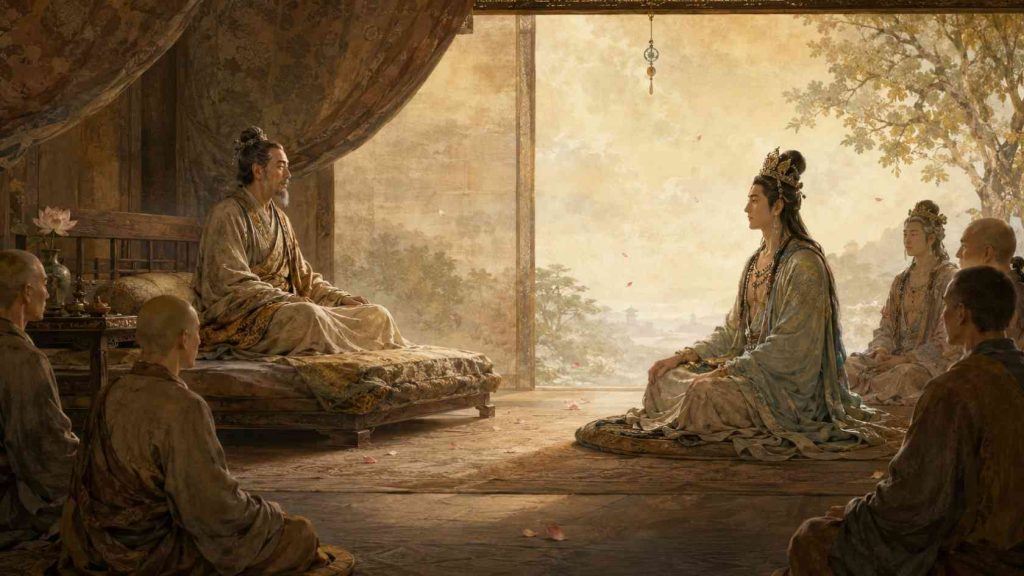
2026/11/15 The inconceivable freedom. Vimalakirti Sutra
In this Dharma workshop, we will study the Vimalakirti Sutra and its message that practice…
2027/01/17 Dharma Workshop: The Heart Sutra. Sunday, January 17
The Heart Sutra The Heart Sutra, Hannya Shingyo as we call it in the Zen…
2027/02/21 Dharma Workshop on the Lotus Sutra. Sunday, Februrary 21
Origin of the Lotus Sutra The Lotus Sutra is a fundamental text in Mahayana Buddhism…
2027/04/18 Bodhisattva Way. Sunday, April 18
The Way of the Bodhisattva The Way of the Bodhisattva is an important concept in…

2027/05/16 Dharma Workshop: The Diamond Sutra. Sunday, May 16
The Diamond Sutra is an ancient Mahayana Buddhist text that is considered one of the…
2027/06/13 17h The Ten Foundations of Dogen’s Zen.
The Gakudō Yōjinshū, or Ten Foundations of Zen, is a work written by Eihei Dōgen,…
2027/07/18 Dharma Workshop: The Bodhisattva Precepts.
The Bodhisattva Precepts There is a story that clearly illustrates the meaning of the bodhisattva…
2027/09/19 Dharma workshop: The platform sutra of Huineng
The Platform Sutra of the Sixth Ancestor is one of the most influential texts in…
2028/01/16 Bodhicitta. Sunday, January 16. Start Zen Dharma Course 2028
What does Bodhicitta or Bodaishin mean? Bodaishin (Japanese) or Bodhicitta (Sanskrit) is a fundamental concept…