


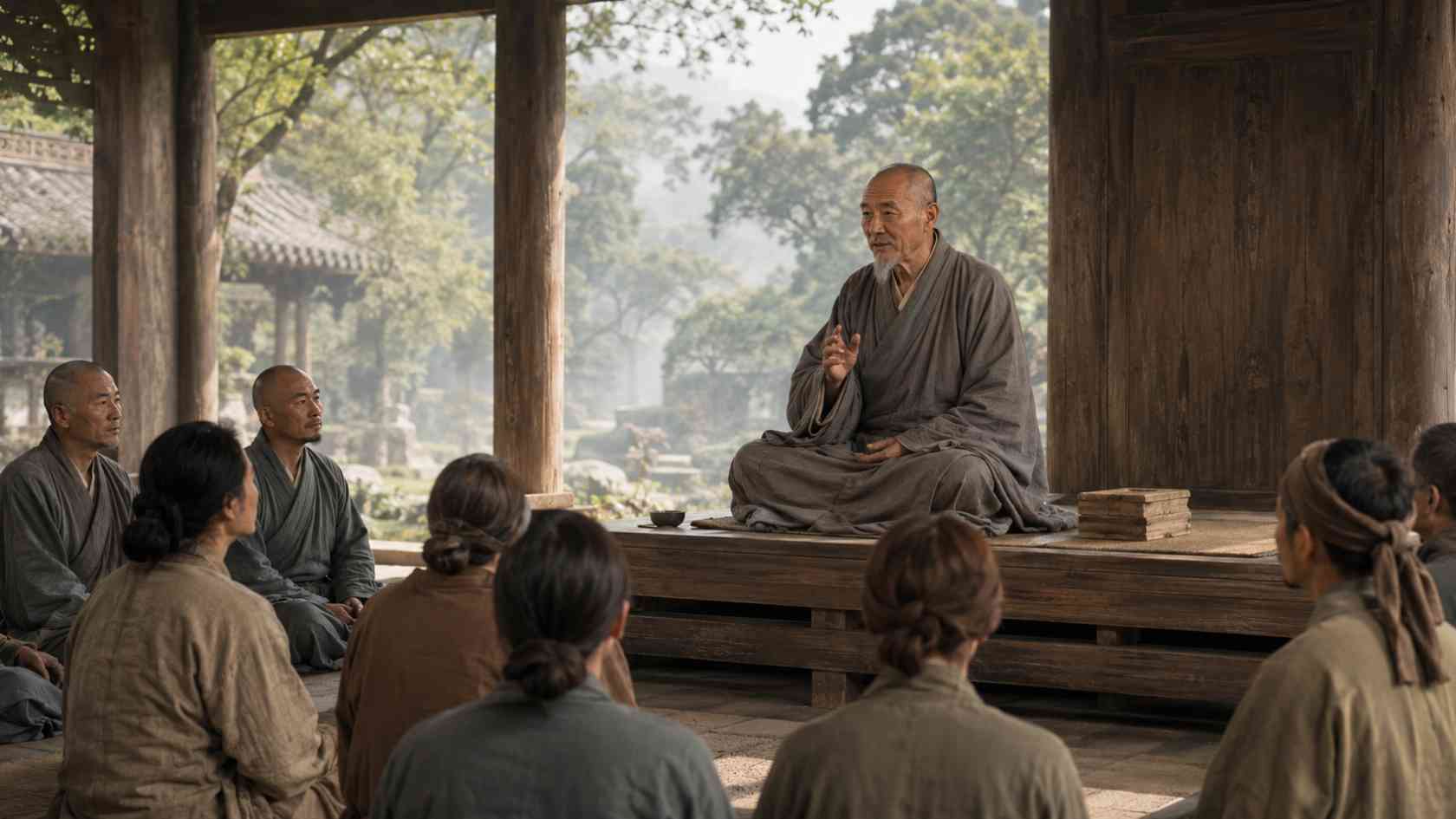
The Platform Sutra of the Sixth Ancestor is one of the most influential texts in the Chan tradition, from which Zen originated. Associated with Huineng (638–713), the Sixth Ancestor of Chinese Chan, it invites us to recognize that awakening is not a distant reality that we must attain, but our original nature, present here and now.
This workshop is part of the Zen Dharma Course offered by Zen Kannon Barcelona and can also be attended independently.
Who was Huineng?
According to tradition, Huineng was a poor young man with no formal education who earned his living by selling firewood. One day, after hearing a passage from the Diamond Sutra being recited, he experienced a profound insight and decided to seek out Master Hongren, the Fifth Ancestor of Chan Buddhism.
At the monastery, Huineng was assigned to work in the kitchen and grind rice. Despite having no formal education and holding no prominent position, he directly understood the essence of the teaching. The well-known story of the verse contest describes how Hongren recognized this understanding and secretly transmitted the Dharma to him, making him the Sixth Ancestor.
Beyond its historical or legendary character, this story questions the idea that awakening depends on education, social status or the accumulation of knowledge.
Why is it called the Platform Sutra?
The platform was the raised structure from which a teacher publicly delivered teachings and conferred the precepts. The text presents itself as a collection of sermons, dialogues and episodes from Huineng’s life.
Unlike the Indian sutras attributed to Shakyamuni Buddha, the Platform Sutra was composed in China. Nevertheless, the Chan tradition granted it the status of a sutra because of the importance and depth of its teachings.
Sudden or gradual awakening in the Platform Sutra
One of its central themes is sudden awakening. Huineng teaches that buddha-nature is already present in all beings. It does not need to be created or acquired: it must be directly recognized.
This does not mean that practice is unnecessary. Awakening may be sudden, but it must be continually actualized through meditation, through our actions and through the way we relate to others.
No-thought, no-form and non-abiding
The Platform Sutra presents three fundamental approaches:
No-thought does not mean leaving the mind blank, but not becoming trapped by thoughts.
No-form means perceiving forms without becoming attached to appearances.
Non-abiding or non-fixation means allowing the mind to flow freely, without settling on any idea, emotion or identity.
Freedom does not consist in eliminating what appears in consciousness, but in not turning it into a prison.
Meditation and wisdom are inseparable
Huineng also rejects the separation between meditation and wisdom, (samadhi and prajna). Meditation is not simply a way of preparing the mind to attain understanding at a later stage. Stillness and clear vision form a single reality, like light and its capacity to illuminate.
The practice of zazen allows us to experience this unity with the whole body, beyond a purely intellectual understanding.
A teaching for everyday life
The Platform Sutra places practice in the midst of the world. Awakening does not depend on escaping from everyday life, but on seeing clearly within each situation. Family, work, relationships and difficulties thus become the very place of the Way.
During the workshop, we will read and discuss some of the sutra’s most significant passages, explore its teachings and consider how they can be put into practice.
The session will begin with zazen meditation. Zen teacher Lluís Nansen Salas will then give a talk on the text, followed by an opportunity for questions and discussion.
No previous reading of the sutra or knowledge of Buddhism is required. The workshop is open both to people approaching Zen for the first time and to practitioners who wish to deepen their understanding of the Dharma.
Dharma workshop on the Platform Sutra
The workshop lasts two hours and consists of a meditation session and a theoretical presentation given by Zen teacher Lluís Nansen Salas.
It will conclude with questions and a discussion among the participants about the subject covered.
Location: Gran Via de les Corts Catalanes, 665, Barcelona.
Single session: €30 (€10 for active members).
See information about the complete course: Dharma Course.
Register for the Dharma workshop on the Platform Sutra
2026/11/15 The inconceivable freedom. Vimalakirti Sutra
In this Dharma workshop, we will study the Vimalakirti Sutra and its message that practice…
2027/01/17 Dharma Workshop: The Heart Sutra. Sunday, January 17
The Heart Sutra The Heart Sutra, Hannya Shingyo as we call it in the Zen…
2027/02/21 Dharma Workshop on the Lotus Sutra. Sunday, Februrary 21
Origin of the Lotus Sutra The Lotus Sutra is a fundamental text in Mahayana Buddhism…
2027/04/18 Bodhisattva Way. Sunday, April 18
The Way of the Bodhisattva The Way of the Bodhisattva is an important concept in…
2027/05/16 Dharma Workshop: The Diamond Sutra. Sunday, May 16
The Diamond Sutra is an ancient Mahayana Buddhist text that is considered one of the…
2027/06/13 17h The Ten Foundations of Dogen’s Zen.
The Gakudō Yōjinshū, or Ten Foundations of Zen, is a work written by Eihei Dōgen,…
2027/07/18 Dharma Workshop: The Bodhisattva Precepts.
The Bodhisattva Precepts There is a story that clearly illustrates the meaning of the bodhisattva…
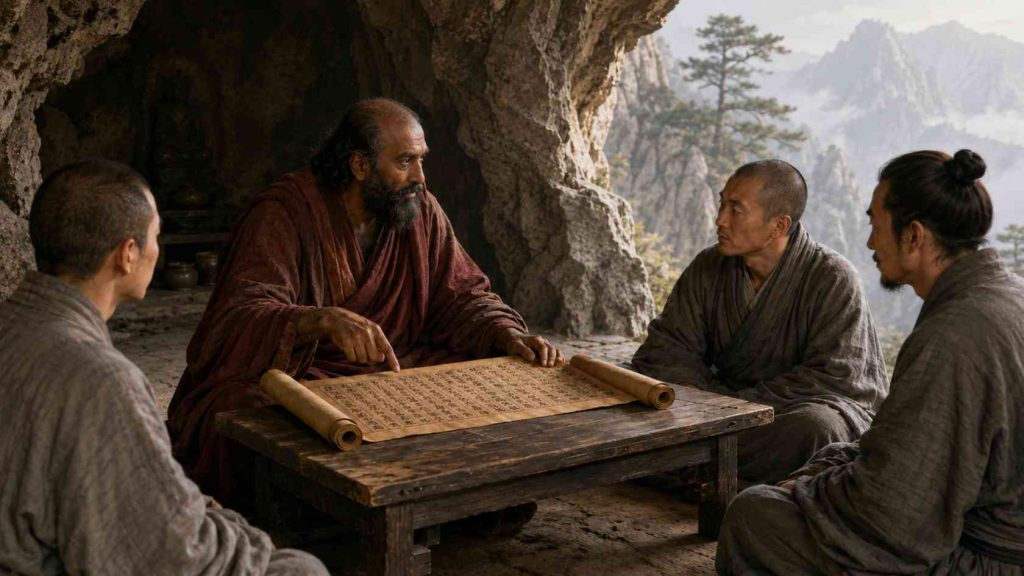
2027/10/10 Bodhidharma. Principle and practice
In this Dharma workshop, we will study Bodhidharma’s Principle and Practice and explore their relationship…
2028/01/16 Bodhicitta. Sunday, January 16. Start Zen Dharma Course 2028
What does Bodhicitta or Bodaishin mean? Bodaishin (Japanese) or Bodhicitta (Sanskrit) is a fundamental concept…