


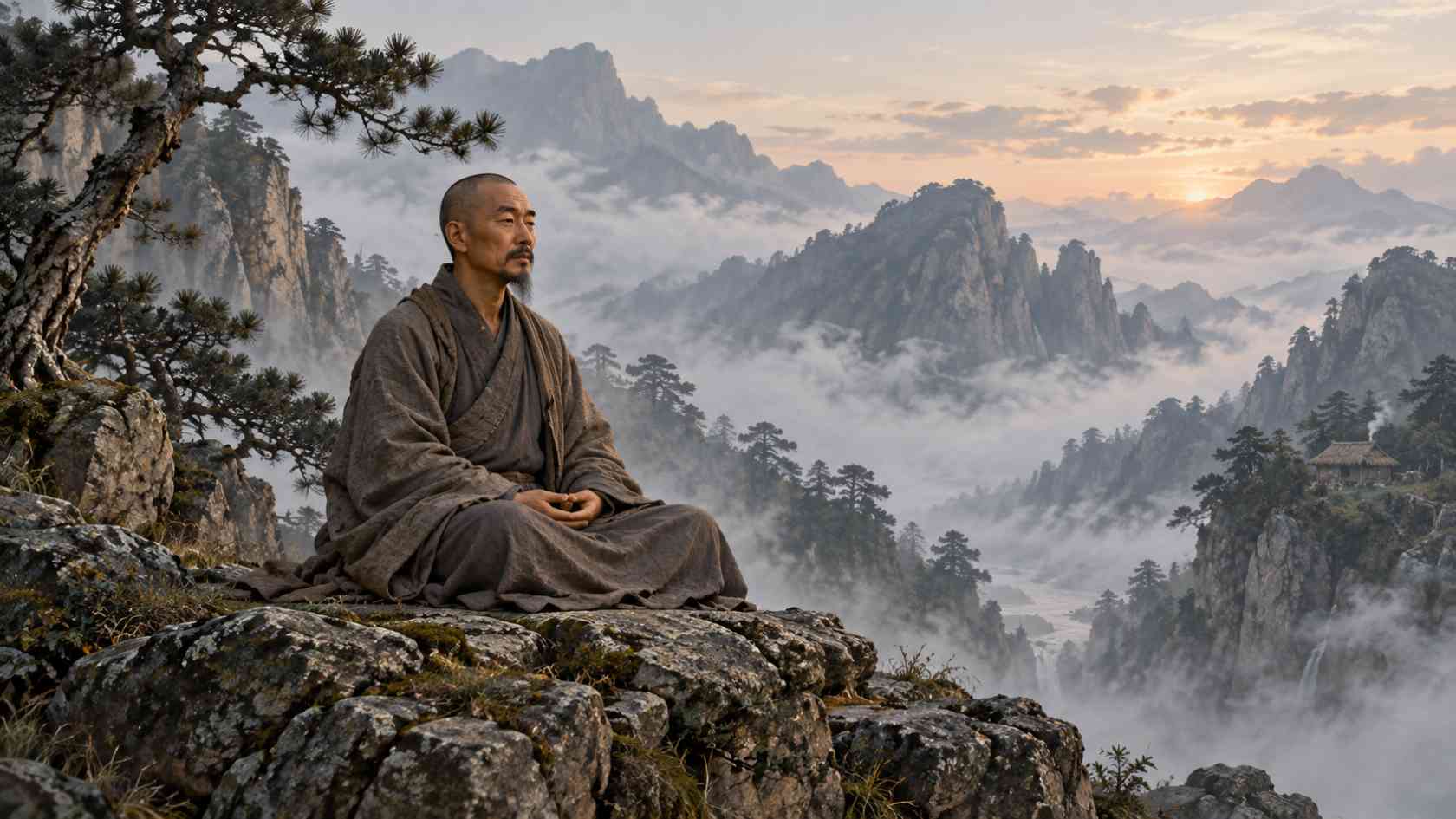
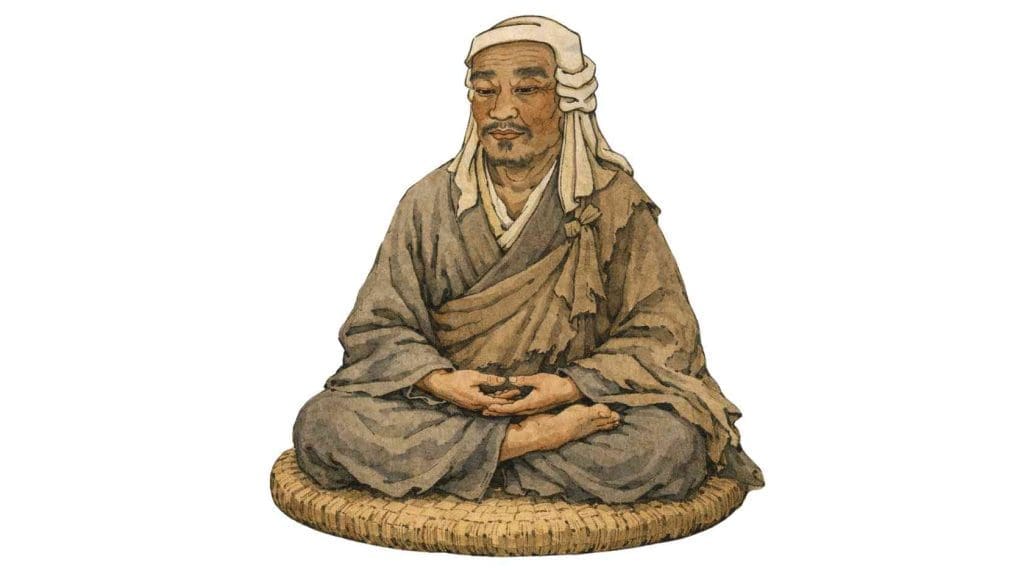
Master Sōsan (jp.), Sengcan(ch.), Huike’s successor and Daoxin’s Master, occupies an essential place in the lineage of Chinese Zen. Tradition attributes the Xinxinming to him, a poem that invites us to abandon grasping and rejection in order to discover a mind that is not separate from reality.
Master Sōsan (jp.), Sengcan(ch.), is regarded as the Third Ancestor of Chan—Chinese Zen—after Bodhidharma and Huike. He received the transmission from Huike and entrusted it to Daoxin, keeping alive the thread of a tradition that was still fragile and followed by very few people.
We know very little about his life with certainty. The sources recounting his biography were written much later and combine memories of the lineage, teachings, and symbolic stories. It is therefore important to approach Sengcan from two perspectives: respecting the spiritual power of the tradition while distinguishing it from what can be historically verified.
The encounter with Master Huike
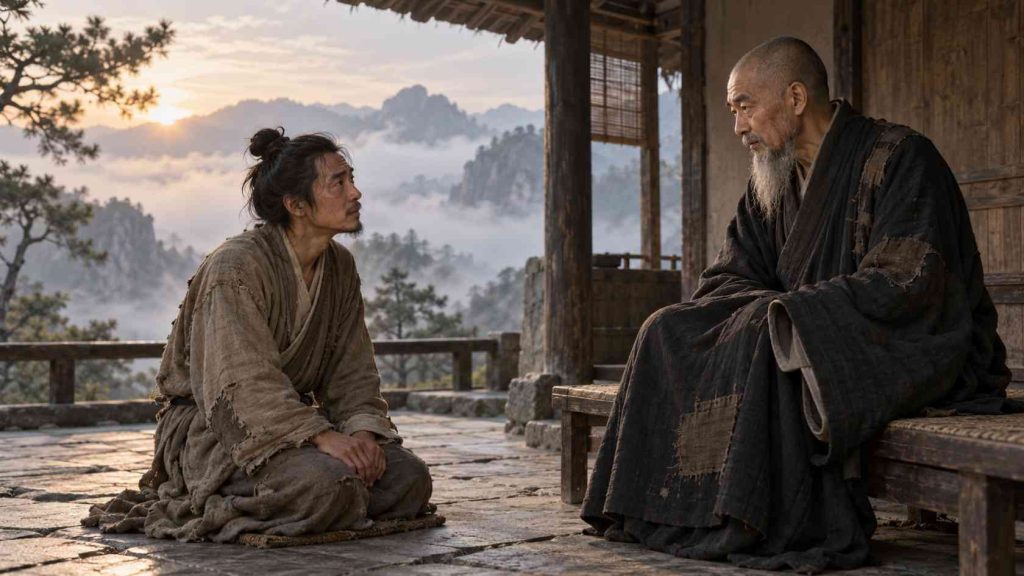
According to the traditional account, Master Sengcan was still a layman when he went to meet Huike. He was suffering from a serious illness and believed that his suffering was a consequence of his karma. He asked the master to purify him.
Huike replied: “Bring me your karma, and I will free you from it.” After searching deeply, Master Sengcan said that he could not find it. Huike replied that, in that case, he was already free.
This dialogue does not deny suffering or the consequences of our actions. It points out that when we search for a fixed and separate self that could possess guilt forever, we cannot find it. Practice allows us to take responsibility without turning the past into an immutable identity.
Huike recognized his disciple’s understanding, gave him the monastic name Master Sengcan—which can be interpreted as “Jewel of the Sangha”—and, according to tradition, transmitted Bodhidharma’s bowl and kesa to him as signs of the continuity of the Dharma.
Practice in difficult times
Master Sengcan lived during a period of political instability and persecution of Buddhism. Accounts of the lineage tell us that he spent many years in retreat in the mountains. His life evokes a discreet and patient practice, free from the need for recognition.
At that time, Chan Buddhism had not yet become a large, organized school. Its transmission depended on encounters between a small number of people willing to practise and preserve the teaching. Master Sengcan represents the almost invisible thread connecting Bodhidharma and Huike with Daoxin and, later, with Hongren and Huineng.
The transmission from Master Sengcan to Daoxin
Tradition tells us that the young Daoxin asked Sengcan to show him the gate of liberation. The master asked him who was keeping him in chains. When Daoxin replied that no one was binding him, Sengcan helped him see that freedom did not have to come from outside. This teaching summarizes an essential aspect of Zen: we search for a way out as if our original nature were imprisoned somewhere, but practice leads us to investigate directly who is bound and what substance the chains truly have.
Daoxin would become the Fourth Ancestor and make a decisive contribution to the establishment of more stable practice communities. In this way, the transmission that Master Sengcan had quietly preserved began to take root and spread.
The Xinxinming, the poem of faith in mind
Sōsan is known above all because tradition attributes the Xinxinming (信心銘), called Shinjinmei in Japanese, to him. Its title can be translated as Inscription on Trusting the Mind. It is one of the oldest and most cherished poems in Zen, and it begins with a statement that has echoed across the centuries:
“The Way of Zen is not difficult; one need only avoid preferences.”
The poem shows us how the mind creates separation when it becomes trapped between attraction and rejection, affirmation and negation, existence and non-existence. The Way becomes clear when we stop clinging to extremes and return to direct, open, and undivided experience.
“Trust in the mind” does not mean blindly believing our thoughts. It means trusting the awakened nature that manifests when we neither appropriate what arises nor reject it. It is the silent trust of zazen: sitting without pursuing any result, present in body and mind, intimate with the whole of experience.
Modern historical research questions whether Sengcan was the actual author of the poem and suggests that it was probably composed at a later date. Nevertheless, the tradition has transmitted it under his name for centuries. This attribution expresses a profound affinity between the figure of Sengcan and the teaching of the text: not becoming trapped in oppositions, not seeking freedom outside ourselves, and trusting in practice.
To explore this teaching more deeply, you can consult the Zen meditation workshop on the Xinxinming, in which we will combine zazen and teaching.
What does Master Sengcan teach us today?
The figure of Master Sengcan reminds us that the Dharma is not always transmitted through great institutions or famous figures. Sometimes it passes silently from one person to another, sustained by practice and trust.
His teaching invites us to look closely at the separations we create: between ourselves and others, between practice and everyday life, and between what we would like to be and what we are. When we stop feeding this division, we can respond to each situation with greater freedom and compassion.
Master Sengcan thus occupies an essential place in our lineage. Between Huike and Daoxin, he preserved the flame of Chan during difficult times. Forever associated with the Xinxinming, he continues to show us that the Way appears precisely when we abandon our struggle against experience and return, with trust, to the present moment.
Master Sengcan within the Zen lineage
From the time of Bodhidharma’s arrival, Buddhism was transmitted along a very fragile thread that reached Huineng. It was during the period of the first six ancestors that Zen is considered to have crystallized and acquired its essential characteristics. The transmission line of the first six ancestors is:
Bodhidharma → Huike → Sengcan → Daoxin → Hongren → Huineng
This thread of transmission would continue in China and later reach Japan through Dōgen. In the Sōtō tradition, lineage is not merely a succession of names: it expresses the living transmission of zazen from teacher to disciple, all the way to the communities practising today.
The masters of our lineage
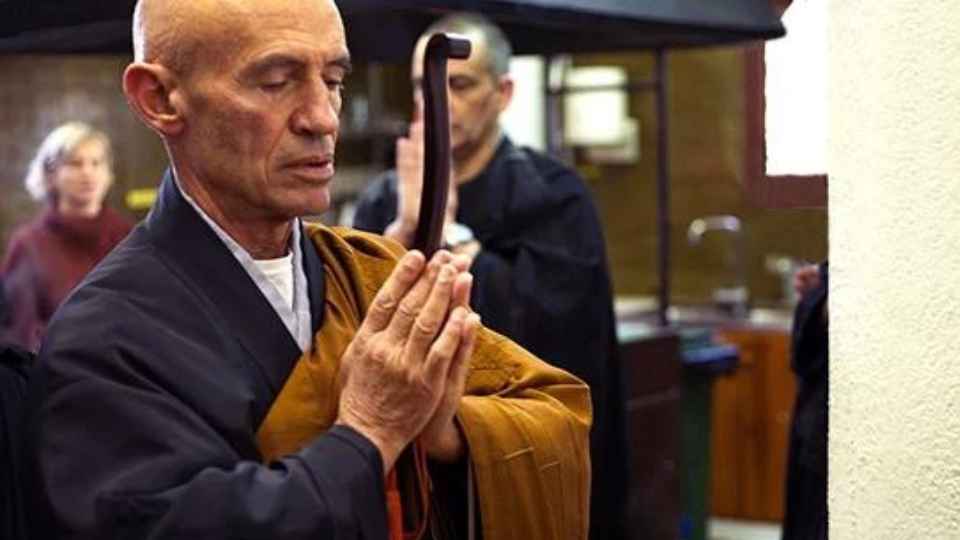
Roland Yuno Rech, Zen Master
Roland Yuno Rech, born in 1944, graduated from the Paris Institute of Political Studies and…
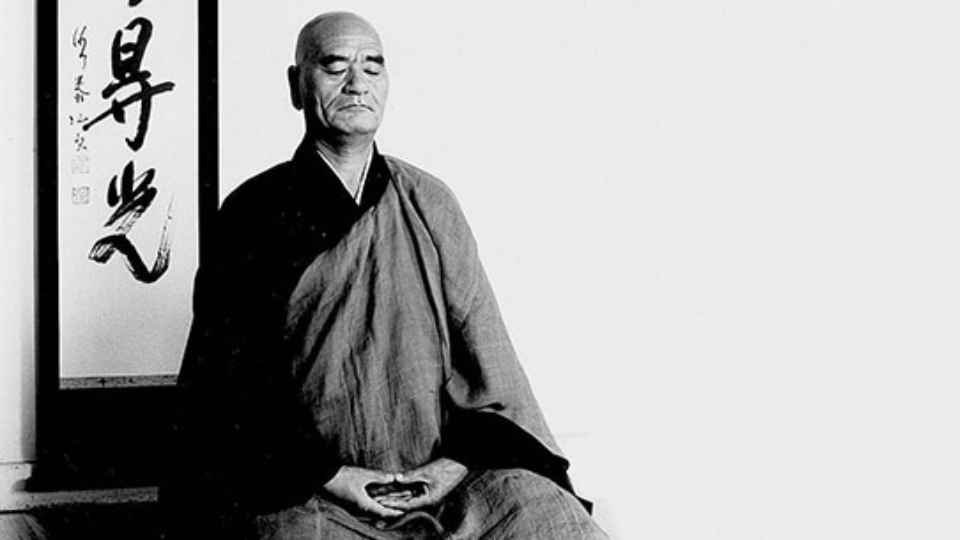
Taisen Deshimaru. The Bodhidharma of modern times
Born in Saga in 1914, Taisen Deshimaru was a disciple of Master Kodo Sawaki, one…
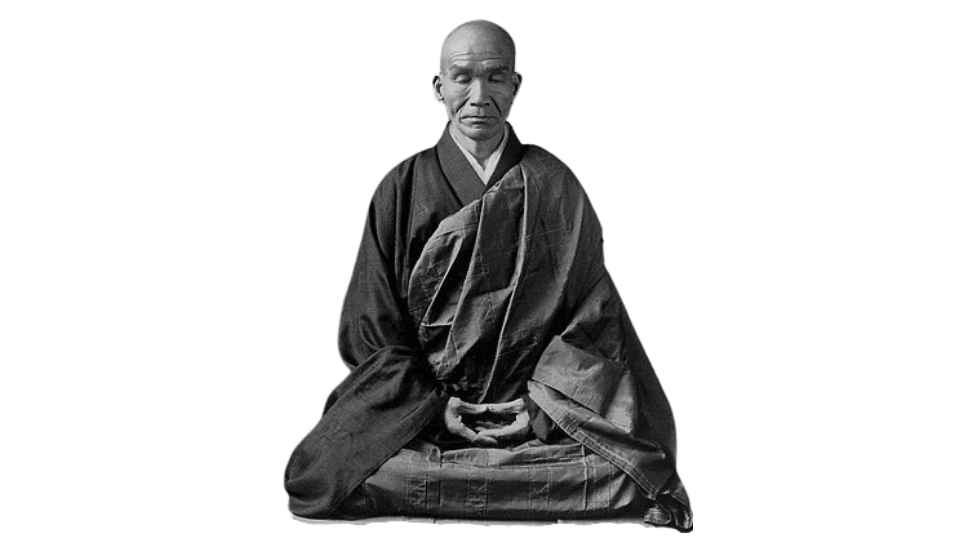
Kodo Sawaki. Homeless Kodo
Kodo Sawaki (1880-1965) was an influential Japanese Zen master, known for revitalizing the practice of…
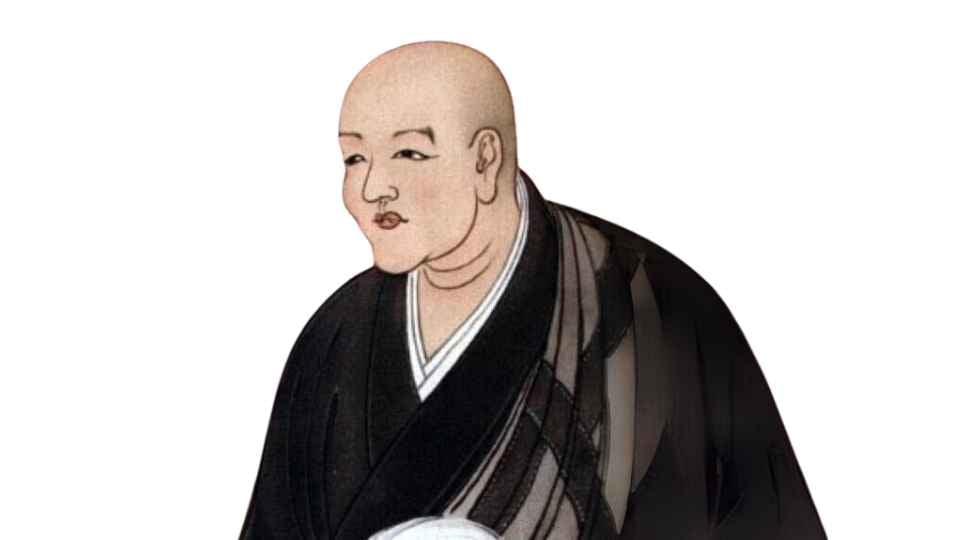
Eihei Dogen. Author of Shobogenzo
Zen Master Dogen (1200-1253) is one of the most influential figures in Japanese Buddhism, particularly…
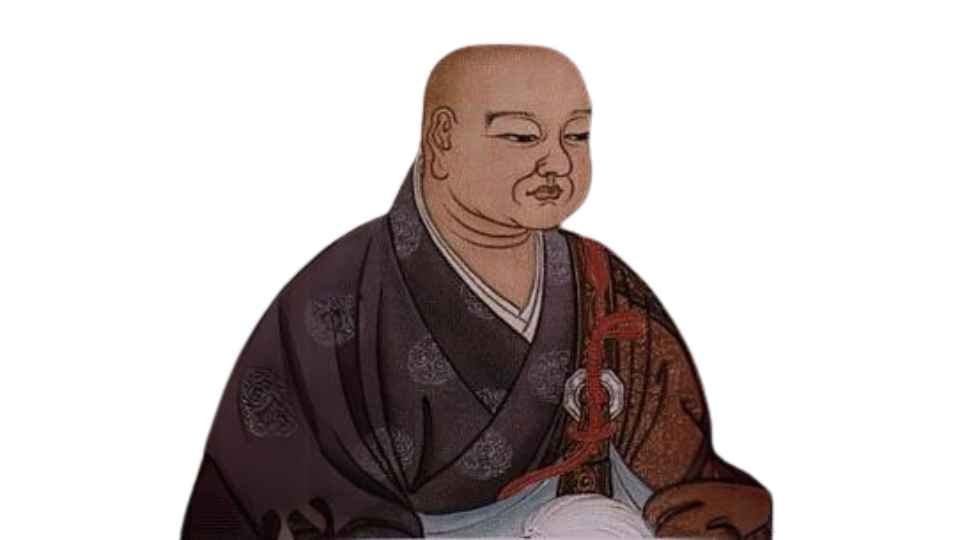
Keizan Jokin. 700th anniversary homage
In the history of Zen, there have been especially brilliant masters. One of them is…
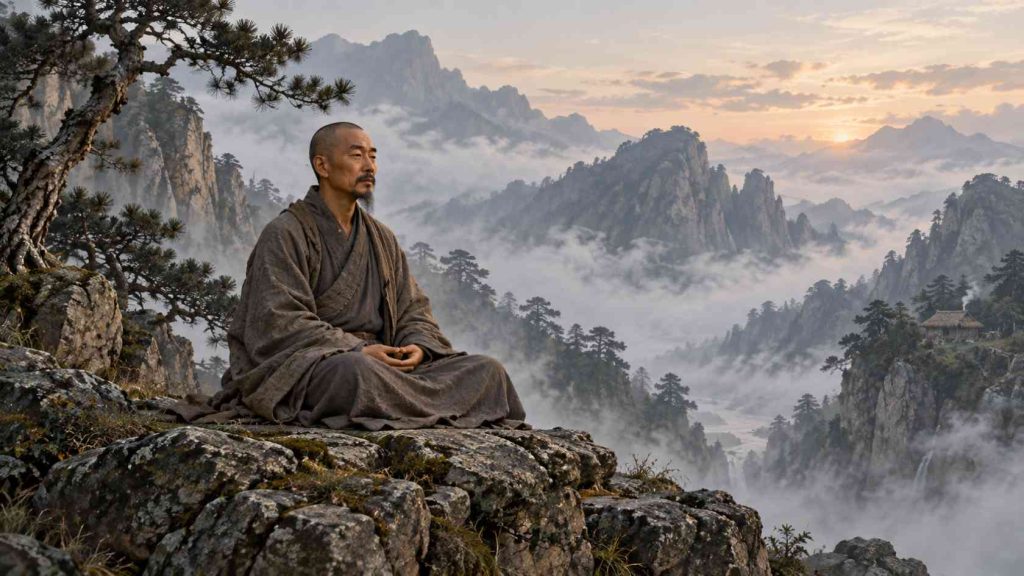
Master Sengcan, The non duality principle
Master Sōsan (jp.), Sengcan(ch.), Huike’s successor and Daoxin’s Master, occupies an essential place in the…
Hui-Neng – Look directly at your mind
Hui-Neng is one of the most important masters in the history of Zen. He lived…
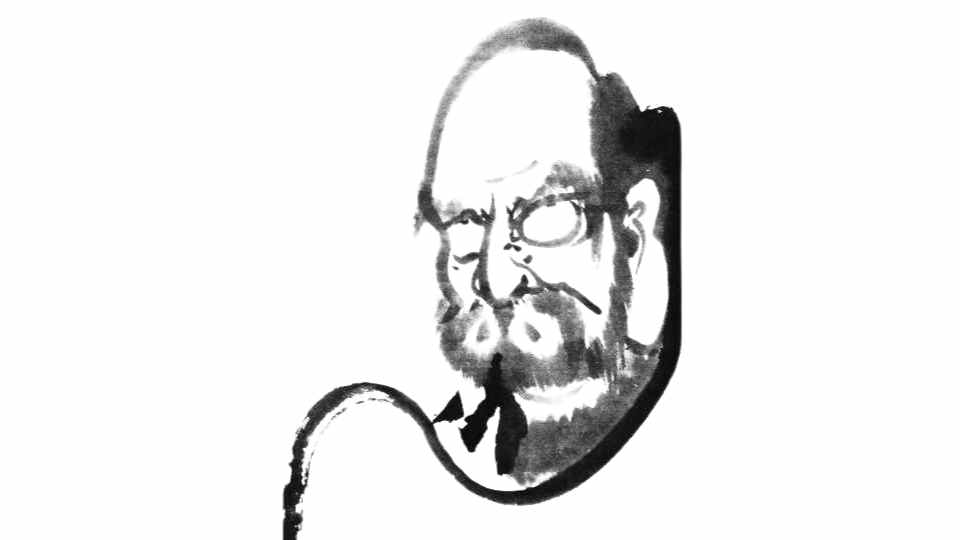
Bodhidharma. Founder of the Zen school
Bodhidharma, often considered the 28th Indian master of Zen and the 1st Chinese master, is…