


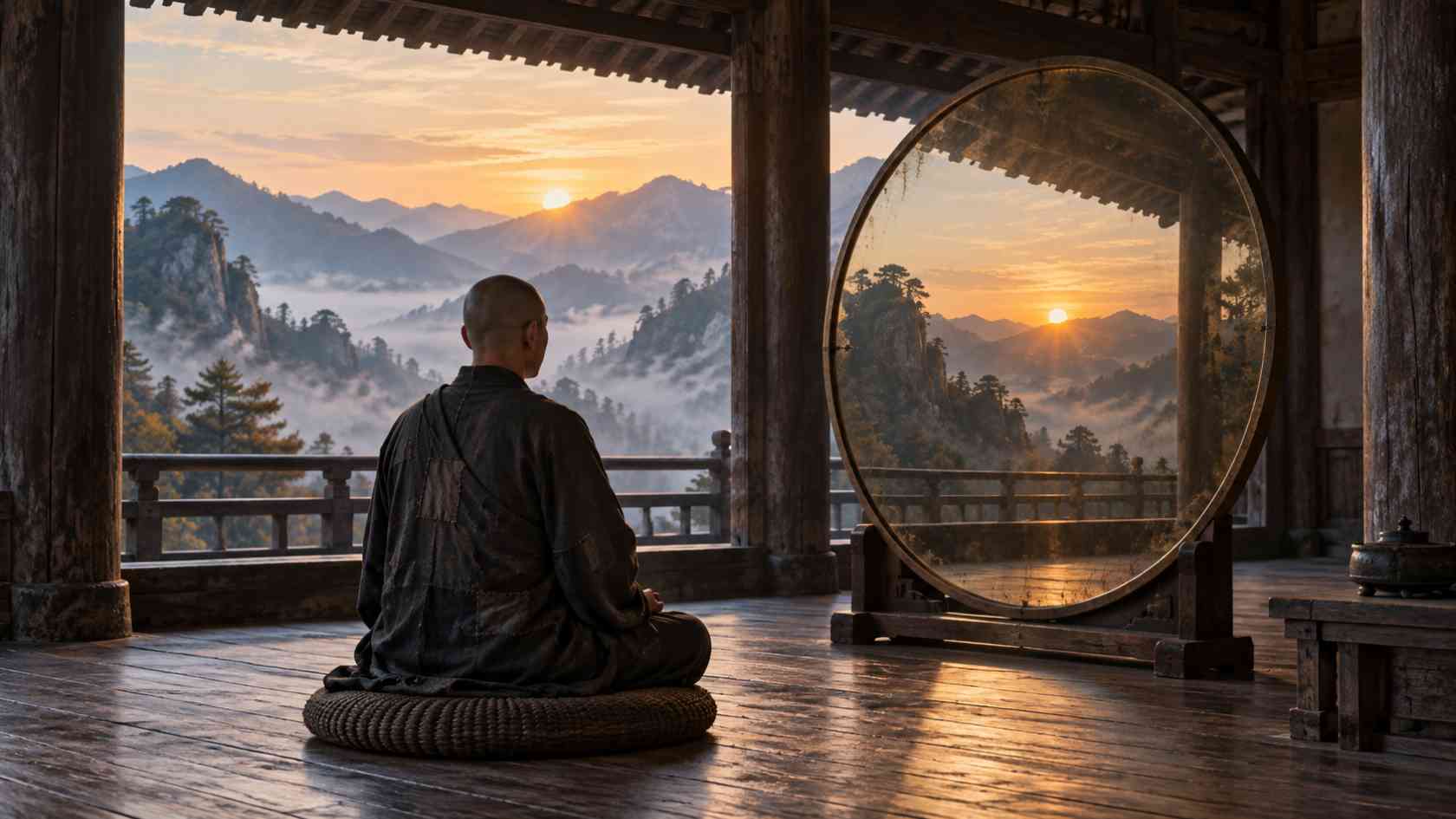
The Hōkyō Zanmai poem, the Samadhi of the Precious Mirror, invites us to discover reality just as it is: intimate, complete and impossible to separate from ourselves. In this Zen meditation workshop, while sitting in zazen, we will listen to the verses attributed to Master Dongshan Liangjie and allow the image of the mirror to illuminate the relationship between unity and duality, emptiness and form, awakening and everyday life.
Hōkyō Zanmai poem, the Samadhi of the Precious Mirror
Without error, without doubt, this is the Dharma.
The buddhas and masters of the transmission have not spoken of it.
Yet you make it real here and now.
Therefore, I beg you: protect it with all your strength.
These are the opening verses of the Hōkyō Zanmai (寶鏡三昧) poem, one of the foundational poems of the Caodong tradition, known in Japan as Sōtō Zen. Its title is translated as The Samadhi of the Precious Mirror. The poem does not describe a special state of consciousness or any extraordinary state separated from life. It speaks of a way of seeing each thing that manifests just as it is and, at the same time, in relation to everything else.
The mirror does not choose what it reflects: it receives light and darkness, movement and stillness, what we like and what we would rather avoid. It clings to no image and rejects none.
But what does it mean to look at our life as if in a precious mirror? How can we recognise unity without erasing differences? And how can we live with differences without turning them into separation and conflict?
In this workshop, we will listen to the Hōkyō Zanmai poem through the experience of zazen. Our purpose will not be to interpret an ancient poem, but to allow its images to guide our posture, our breathing and the way we relate to each situation.
The mirror that retains nothing
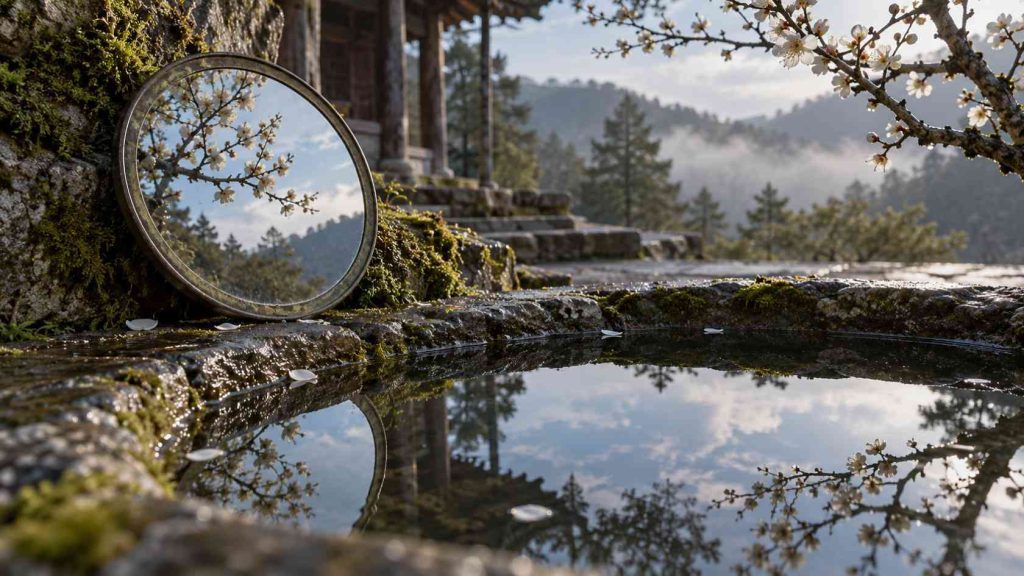
When we look at ourselves in a mirror, the form and its reflection appear together. They are not the same thing, yet neither can they be separated. The poem uses this image to express a central experience of Zen: we are not isolated entities facing the world, but neither do we disappear into an undifferentiated whole.
“As before a precious mirror, form and reflection behold one another. This is me, but I am not this.”
During zazen, we can observe this relationship directly. We feel the body, sounds, breathing and thoughts. Each phenomenon has its own particular form, but none exists on its own. Breathing depends on the air; the body depends on the earth and on food; our identity depends on all the relationships that have shaped us.
The practice does not ask us to deny individuality. It helps us stop mistaking it for a separate, fixed existence. Like the reflection in the mirror, we are fully ourselves and, at the same time, inseparable from everything that appears.
Suchness: things just as they are
The poem speaks of the Dharma of suchness: reality just as it is before we divide it through our judgements. This does not mean contemplating the world passively or accepting injustice. It means seeing clearly enough not to confuse facts with the projections, fears and desires that we add to them.
When we practise zazen, we do not try to manufacture a perfect experience. We return to posture and breathing, and allow each phenomenon to be exactly what it is: a thought is a thought, an emotion is an emotion, a sound is a sound. There is no need to drive anything away or turn anything into an identity.
This intimacy with experience allows us to respond more freely. Seeing things as they are does not immobilise us; it helps us act without being completely swept away by our habitual reactions.
Unity does not eliminate differences
One of the great themes of the Hōkyō Zanmai poem is the relationship between the absolute and the relative. From the perspective of unity, all phenomena share the same empty and interdependent nature. From the perspective of difference, every being, every encounter and every moment is unique.
If we cling only to difference, the world becomes fragmented into self and others, winners and losers, friends and enemies. If we cling only to unity, we may ignore specific circumstances, suffering and responsibility. The poem invites us not to become trapped in either extreme.
In practice, unity and difference illuminate one another. Precisely because we are not separate from others, every difference matters. And precisely because each person occupies a unique place, we can contribute to the good of all from within our specific circumstances.
Light within darkness, darkness within light
The Hōkyō Zanmai poem plays with images of light and darkness. Light can represent the diversity that becomes visible; darkness, the unity in which distinctions cease to dominate us. Neither is superior to the other.
Our lives also alternate between understanding and confusion, confidence and doubt, openness and resistance. The Way does not consist in settling forever on the side of light. When we stop struggling against darkness, we can discover depth within it; when light appears, we do not need to claim it as our own. This is a valuable teaching for difficult times. Practice does not promise that everything will become clear, but that we can remain present without abandoning any part of our experience.
A teaching for everyday life
We often look at reality as though it were a mirror that should confirm the image we have of ourselves. We seek approval, reject criticism and interpret every situation according to our expectations. When the reflection does not match what we would like to see, frustration and conflict arise.
The precious mirror works differently. It reflects without adding and lets things pass without retaining them. Practising with this image helps us listen without immediately preparing a response, recognise an emotion without obeying it, and act without turning the outcome into a measure of our worth.
This is not about becoming cold or indifferent. On the contrary, when the self no longer fills the whole mirror, we can see the needs of others more clearly and respond with greater wisdom and compassion.
Dongshan and the Hōkyō Zanmai poem
Tradition attributes the Hōkyō Zanmai poem to the Chinese master Dongshan Liangjie (807–869), known in Japanese as Tōzan Ryōkai and considered one of the founders of the Caodong lineage. For centuries, the poem has been transmitted in association with his name and with his teaching on suchness and the Five Ranks. Modern historical research, however, points out that the text is first documented more than two centuries after Dongshan’s death and that his actual authorship cannot be confirmed.
This historical caution does not diminish the poem’s value: it allows us to distinguish between what can be documented and the way the tradition has received, practised and transmitted it. To learn about the master’s life, dialogues and teaching, you can read the biography of Dongshan Liangjie.
You can find the complete Hōkyō Zanmai poem with commentary by Lluís Nansen in his book Dharma Zen, l’ull de la joiosa revelació, 2019, Viena edicions, Barcelona
Zen meditation workshop on the Hōkyō Zanmai poem
Date: Saturday, 14 November
Time: 5:00–7:00 p.m.
Format: in person at Zen Kannon Barcelona and online via Zoom
Duration: two hours
During this Zen poetry meditation workshop, we will alternate zazen and kinhin. During zazen, Zen teacher Lluís Nansen will give a teaching, or kusen, based on the Hōkyō Zanmai poem. We will listen to the poem through the body and stillness, exploring its images without separating study from experience. The workshop is part of the meditation course on Zen poems and koans and is suitable both for beginners and for experienced practitioners.
Register for the Hōkyō Zanmai poem workshop
2026/10/10 Meditation with Sengcan Xinxinming poem
The Xinxinming, the poem of faith in mind, invites us to stop being trapped between…
2027/01/16 Koan Mu meditation workshop
The meditation with koan “Mu” is one of the most well-known koans within the Zen…

2027/02/20 Koan Meditation: Ikka’s Bright Pearl
This Bright pearl koan is one of the many paradoxical stories or enigmas that form…
2027/04/17 koan Zazen Shin meditation workshop
What is a koan? In the zazen shin koan meditation, we will introduce the koan…

2027/05/15 Koan Baizhang and the Fox. Saturday, May 15
The Fox in Zen Stories To understand the koan of the fox, it is helpful…
2027/06/12 17h Zen Meditation with the Genjokoan.
Genjokoan: A Zen Meditation Workshop The Genjokoan is a text written by the Japanese Zen…